
Smart Washing Machine Market Overview
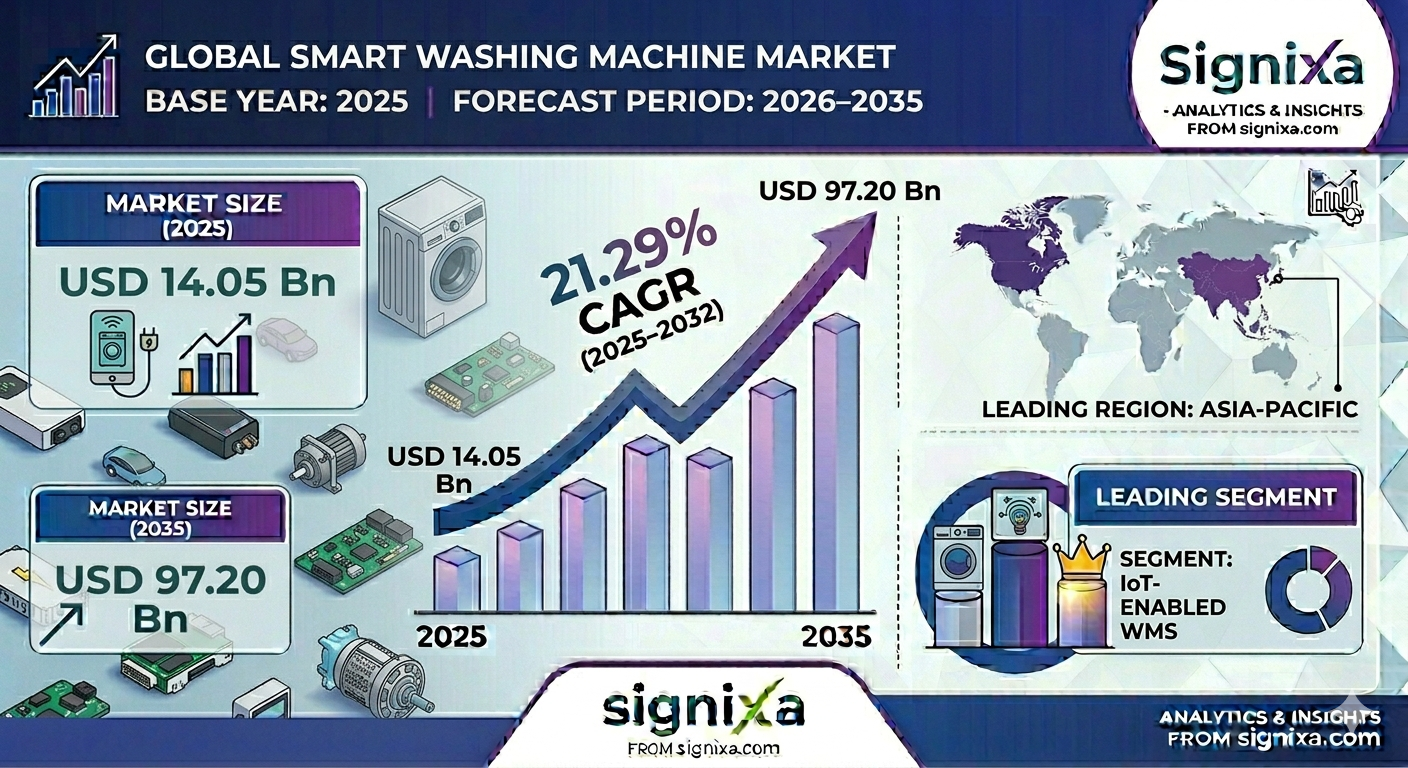
The global smart washing machine market was valued at approximately USD 14.05 billion in 2025 and is projected to reach around USD 97.20 billion by 2035, growing at a compound annual growth rate (CAGR) of roughly 21.29% between 2026 and 2035. The report analyzes market dynamics, key drivers, restraints, opportunities, and competitive trends, with detailed segmentation by product, capacity, and application across global regions.
Smart washing machines integrate IoT, AI, and remote access technologies. They thus offer varying intelligent wash programs, voice control, and smartphone compatibility. They also maximize electricity and water usage, as well as functionality and convenience. Major factors contributing to growth in the smart washing machine market include the expanding consumer preference for connected home appliances, increasing levels of disposable income, and increasing penetration of connected smart home ecosystems. An additional factor further accelerating adoption and growth globally is the replacement of previous model washers with high-performance, energy-efficient smart washing machines.
The smart washing machine market is undergoing robust growth, driven by the increasing integration of IoT technology, changing consumer lifestyles, and rising demand for connected home appliances. These machines offer advanced features such as remote operation via smartphone apps, real-time monitoring, energy usage optimization, and customized wash cycles. Consumers are increasingly drawn to the convenience and time-saving benefits of smart functionality, especially in urban areas where fast-paced lifestyles prioritize automation and efficiency. In addition, rising awareness of energy and water conservation is prompting users to adopt smart appliances that intelligently adjust usage patterns for sustainability.
Manufacturers are investing heavily in R&D to enhance user interfaces, introduce AI-driven features like load detection and fabric care algorithms, and expand compatibility with voice assistants such as Amazon Alexa and Google Assistant. Wi-Fi and Bluetooth-enabled models with predictive maintenance alerts and integration into broader smart home ecosystems are becoming standard offerings in developed regions. Meanwhile, in emerging economies, demand is being supported by the rising middle class, improved internet penetration, and government initiatives promoting energy-efficient appliances. However, high product costs and concerns around data privacy may pose moderate challenges to widespread adoption. Despite this, continued innovation, coupled with strong promotional campaigns and product differentiation strategies, is expected to sustain momentum. The smart washing machine market is poised for strong global expansion, underpinned by consumer preferences for convenience, sustainability, and digital connectivity in household appliances.
Key Findings
- The market is forecast to expand at a CAGR of 21.29% from 2026 to 2035.
- Front load machines dominate the product category and are expected to maintain this lead.
- The 6-10 kg capacity segment held the largest share in 2025 and is projected to grow the fastest.
- Residential applications account for the largest share due to rapid urbanization and rising middle-class demand.
- Asia-Pacific leads the market, supported by a surge in smart home adoption and regional manufacturing hubs.
Smart Washing Machine Market Dynamics
Rising Demand for Smart Home Technologies & IoT Integration
As consumers desire higher automation and control over home appliances, smart washing machines are becoming more common. With features like auto detergent dosing, AI-fabric sensing, and Wi-Fi integration, these products offer superior performance and a better user experience. According to the GSMA, global demand for smart home technologies will increase, and it is predicted that in 2024, over 60% of households will access smart home technologies. This trend will only push more consumers to look for smarter options for laundry functionality.
Urbanization, Dual-Income Families & Remote Convenience
Urbanization and two-income families are increasing the need for appliances that do work for consumers. Smart washers can be scheduled and monitored remotely, which can reduce manual input by the consumer to simply one click. In 2023, over 40% of consumers in urban areas in China and the U.S. preferred smart appliances. Government programs that support energy-efficient appliances, and increasing electricity and water bills, have lead consumers to view smart washers as energy-efficient home appliances that use water and electricity wisely.
AI-Enabled Innovation, Energy & Water Efficiency
Manufacturers are closely associating AI-enabled decision-making into machines to execute more performant and predictive maintenance. Smart washing machines currently offer potential energy savings of 30% and provide over 40% water savings compared to traditional washers. In addition, Refrigeration & Appliances manufacturers in partnerships with technology organizations are moving innovation quickly—Samsung, LG, and Whirlpool have all introduced AI-powered washers that learn consumer behaviours and washing patterns that will become more efficacious over time.
Evolving Consumer Behaviour, Sustainability & Regulatory Push
The growth of the smart washing machine market is significantly influenced by evolving consumer behaviour, increasing technological adoption, and growing urbanization. Consumers are now actively seeking appliances that provide enhanced convenience, time-efficiency, and energy savings. As more people shift toward connected lifestyles, smart washing machines have gained prominence due to their remote-control capabilities, integration with smart home systems, and intelligent sensors that optimize detergent use and water consumption. The rising penetration of smartphones and Wi-Fi infrastructure globally has further supported this trend. Moreover, environmental awareness is encouraging the adoption of energy- and water-efficient appliances, which many smart washing machines are specifically designed to deliver. Manufacturers are responding with innovations that allow users to schedule wash cycles remotely, receive maintenance alerts, and even monitor usage statistics for better utility management. These benefits are especially appealing in regions with higher electricity tariffs or water scarcity. The push from regulatory bodies for eco-friendly products is also aligning with these advancements, fostering a favourable landscape for manufacturers to expand their smart appliance portfolios.
Challenges: High Costs, Data Privacy & Complexity of Use
On the other hand, several challenges could hamper market growth. One major concern is the high upfront cost of smart washing machines, which remains a barrier in price-sensitive markets, particularly in developing countries. Although long-term cost savings from energy efficiency are considerable, initial affordability continues to limit adoption. Additionally, concerns about data privacy and cybersecurity have emerged due to the increasing connectivity of home appliances. As smart washing machines transmit user data over networks, consumers may hesitate if they perceive risks of data breaches or unauthorized access. Another obstacle lies in the complexity of use; older demographics or less tech-savvy consumers may find it difficult to adapt to app-controlled systems and advanced features. Furthermore, network dependency may impact the user experience in areas with unreliable internet infrastructure. Manufacturers need to strike a balance between innovation and user-friendliness while ensuring robust data security protocols. Despite these hurdles, the market's trajectory remains optimistic, supported by consistent product enhancements, strategic partnerships with tech firms, and aggressive marketing campaigns that focus on lifestyle benefits and sustainability.
Smart Washing Machine Market Segmentation Analysis
By Product Type Segment Analysis
The market is segmented by product type, with each category exhibiting distinct consumer drivers and growth trajectories:
Front Load Smart Washing Machines
Front load smart washing machines continue to dominate the market due to their high energy efficiency, minimal water consumption, and advanced features including in-built heaters and auto-load sensing. Due to space efficiency, energy, and performance, front load washing machines tend to be the preferred option in Europe and Asia-Pacific. According to BSH Home Appliances, front loaders use 30–50% less water than top-load machines, making them a more affordable option. Also, front-load systems are more compatible with AI features and integration into smart home networks, and therefore have a wider adoption by higher-end and mid-range consumers.
Top Load Smart Washing Machines
Top Load Smart Washing Machines are slower to completely displace front loaders in energy efficiency measures but are quite popular in North America and some countries in the Asia-Pacific for their easier usability and lower overall initial cost. Top load smart washers are also beginning to introduce features like rapid wash cycles, voice assistant functionality, and app control. All of the changes to design and wash technology are paving the way for more top load smart washers to emerge, especially in regions with emerging markets, where front load washers may remain too expensive to be adopted for whole segments of the populations.
By Capacity Segment Analysis
The 6–10 kg segment represented the largest revenue share in 2025 and will capture the highest share of the global market through 2032. This capacity range is ideal for small to medium-sized households, and is the most frequently purchased category in city residential areas. The increasing number of nuclear families signals extensive demand for the segment. In 2025, over 55% of smart washers sold in Asia-Pacific were in the 6–10 kg segment and demand is expected to increase in Europe and Latin America as well.
People and families living in smaller flats and apartments, including student housing, are increasing their ownership of less than 6 kg capacity smart washing machines, especially in metropolitan and urban areas. Compactness, mobility, and low prices are the principal benefits of these machines. Other populations that show interest and increased consumption of these machines are in high-density based countries, such Japan and South Korea. These slightly less than 6 kg capacity smart washing machines accounted for around 20% of the global smart washing machine market in 2025. This trend is largely due to the growth of single-person households.
More Than 10kg machines are targeted at larger families, and commercial use. These machines have higher-output electric motors, larger drums, and artificial intelligence sensors and analytics systems that measure loads and apply detergent optimally for the load. They are generally more expensive and targeted towards the hospitality and laundry sector. According to LG Electronics, sales of 10 kg smart washers grew 18% from 2022 to 2023 and was particularly observed in larger house and family households in the U.S. and UAE, where there is demand for larger capacity.
By Application Segment Analysis
Residential
Residential applications made up more than 75 percent of the market in 2025 and are expected to dominate until 2032. This growth is primarily driven by the expanding smart home sector, living standards, and consumers' need for time saving appliances. Many of the main markets in the world are countries like India and Brazil, where smart appliance penetration is also growing at a rate of greater than 15 percent CAGR, which indicates a large growth opportunity. Manufacturers are targeting this demographic with energy-efficient, compact and voice-controlled washers benefiting urban lifestyles.
Commercial
Commercial uses are laundromats, hotels, hospitals, and other institutions. Our commercial customers prefer smart washers and smart dryers with heavy duty cycles, real time cloud monitoring, and automatic maintenance. Their need for minimizing costs and improving services make these machines suitable for larger user segments. In 2024, commercial applications accounted for approximately 25% of worldwide sales, and the demand has justified a continued upward trend with growth expectations for the hospitality sector and hygiene requirements in nursing and educational sector requirements.
Report Attributes & Market Scope
| Report Attribute | Details |
|---|---|
| Market Size Value in 2024 | USD 14.05 Billion |
| Market Size Value in 2032 | USD97.20 Billion |
| CAGR (2025–2032) | 21.29% |
| Base Year Used for Estimation | 2025 |
| Historic Data | 2020 - 2024 |
| Forecast Period | 2026 - 2035 |
| Segments Covered – By Product Type |
|
| Segments Covered – By Capacity |
|
| Segments Covered – By Application |
|
| Regions Covered | North America, Europe, Asia Pacific, Latin America, Middle East and Africa |
| Major Countries Covered | U.S., Canada, Mexico, Germany, UK, France, Italy, Spain, Russia, China, Japan, South Korea, India, Southeast Asia Countries, Brazil, Argentina, GCC Countries, Turkey, Iran, Israel, South Africa, Egypt, Nigeria, etc. |
| Key Companies Profiled | LG Electronics, Samsung Electronics, Whirlpool Corporation, Haier Group, Bosch, Electrolux, Panasonic, Midea, Hitachi, and Godrej, among others. |
Smart Washing Machine Market Regional Analysis
The Asia-Pacific region accounts for a large portion of the global smart washing machine market globally, due to factors such as rapidly growing urbanization, growing disposable income, and the presence of major manufacturers including Samsung, Haier, and LG. Furthermore, China, Japan, and South Korea are at the forefront of both production and adoption of these new smart technologies. Next in line is North America where the emergence of new connected technology is being driven by early adopters, smart home integration, and energy regulations. Europe is growing steadily in these markets due largely to sustainability mandates and energy efficiency standards. Latin America and the Middle East & Africa make up the emerging portion of this market, which we expect to see continued penetration as the communities develop infrastructure and begin to create a larger middle-class demographic.
Asia-Pacific (Largest Region)
The Asia-Pacific region accounts for a large portion of the global smart washing machine market, due to factors such as rapidly growing urbanization, growing disposable income, and the presence of major manufacturers including Samsung, Haier, and LG. Furthermore, China, Japan, and South Korea are at the forefront of both production and adoption of these new smart technologies. In 2025, over 55% of smart washers sold in Asia-Pacific were in the 6–10 kg segment and demand is expected to increase in Europe and Latin America as well. The region's vibrant e-commerce landscape is a significant growth driver, making smart washing machines more accessible to a vast consumer base. The demand for energy-efficient smart appliances is also gaining traction, particularly in markets like India, driven by affordability concerns and government incentives promoting sustainable household products. As consumer awareness about responsible energy consumption grows, transparency in product specifications and performance is becoming increasingly important, influencing purchasing decisions across the region.
North America
North America plays a prominent role in the smart washing machine market, driven by high levels of consumer awareness, rapid adoption of smart home technologies, and a strong preference for energy-efficient appliances. The U.S. and Canada exhibit substantial demand for advanced household devices, with consumers increasingly opting for smart washing machines that offer remote control, scheduling, real-time diagnostics, and compatibility with home automation systems. The presence of robust Wi-Fi infrastructure and widespread smartphone penetration facilitates seamless integration and operation of these appliances, further encouraging adoption. In North America, manufacturers focus on product innovation, offering models with AI-enabled fabric care, automatic detergent dispensing, and water-saving features. Government initiatives promoting energy conservation, such as ENERGY STAR certification programs, also contribute to market growth by encouraging consumers to choose efficient appliances. Additionally, growing interest in sustainability and environmental impact has led households to invest in smart washers that reduce energy and water consumption. Retail chains, e-commerce platforms, and exclusive brand outlets ensure wide product availability, making it easy for consumers to explore and compare features. However, challenges such as high initial costs and concerns over data security may affect certain buyer segments. Nonetheless, North America's advanced digital ecosystem, strong R&D culture, and increasing household expenditure on smart appliances will continue to position the region as a key driver in the global smart washing machine market over the forecast period.
Europe
Europe represents a mature and technologically advanced market for smart washing machines, supported by a strong emphasis on sustainability, energy efficiency, and smart home integration. Consumers in countries such as Germany, the UK, France, and the Nordics exhibit a high preference for intelligent home appliances that align with their eco-conscious lifestyles. The European Union's strict energy regulations and initiatives like the Ecodesign Directive and Energy Labelling Framework have accelerated the adoption of appliances that reduce power and water consumption. Smart washing machines equipped with advanced sensors, AI-driven cycle optimization, and remote-control capabilities have gained significant traction across urban households. Additionally, increasing awareness about water scarcity and climate impact is prompting more consumers to invest in appliances that provide real-time monitoring and efficiency reporting. The widespread availability of high-speed internet, coupled with robust infrastructure for IoT devices, supports seamless functionality of these machines. Moreover, regional manufacturers are continuously innovating to enhance user experience, focusing on intuitive interfaces, smart diagnostics, and voice-command integration through assistants like Alexa and Google Assistant. E-commerce platforms and retail giants in Europe are also actively promoting smart washing machines through bundled offers and seasonal discounts, driving purchase decisions. Despite the region's strong growth potential, barriers such as high unit prices and digital privacy concerns persist. Some segments of the population, particularly in Eastern Europe, still prefer traditional models due to cost sensitivity or limited tech exposure. However, with growing urbanization, increased disposable income, and rising demand for low-carbon technologies, Europe is expected to remain a leading hub for smart washing machine innovation and adoption.
Middle East & Africa
The Middle East & Africa smart washing machine market is experiencing steady growth, driven by urbanization, rising disposable incomes, and increasing awareness of energy-efficient home appliances. Countries like the UAE, Saudi Arabia, and South Africa are seeing rapid infrastructure development and a growing middle-class population, which is fuelling the demand for modern household devices, including smart washing machines. Consumers in metropolitan areas are showing a preference for appliances that offer convenience, automation, and water-saving features, especially in regions where water scarcity is a concern. Wi-Fi-enabled models with remote monitoring, smart scheduling, and AI-based cycle recommendations are gaining popularity, particularly among tech-savvy younger demographics. Government efforts to promote sustainable living, such as green building codes and energy-efficiency incentives, are encouraging consumers to adopt smart appliances that align with environmental goals. E-commerce growth in the region is also making smart washing machines more accessible, with online platforms offering product comparisons, reviews, and delivery options. However, the market still faces challenges such as high initial costs, limited consumer awareness in rural areas, and variable internet connectivity, which can affect smart device functionality. Despite these barriers, the increasing penetration of smartphones and digital platforms, along with expanding retail networks and brand showrooms, is expected to support future growth. Manufacturers are also focusing on product customization to suit local preferences, such as models that handle heavy fabrics or are compatible with local water conditions. With these ongoing developments, the Middle East & Africa is gradually emerging as an important market for smart washing machines, particularly in urban and semi-urban areas.
Latin America
In Latin America, urbanization and rising disposable income are key contributors to the smart washing machine market. Countries like Brazil and Argentina are witnessing growing consumer interest in connected and energy-efficient home appliances. The expanding middle class and increasing brand awareness, coupled with the rise of e-commerce platforms, are making smart washing machines more accessible to a broader consumer base across the region. Smart appliance penetration is growing at a rate of greater than 15 percent CAGR in key markets, which indicates a large growth opportunity for manufacturers targeting this demographic with energy-efficient, compact, and voice-controlled washers suited to urban lifestyles.
Recent Developments in the Smart Washing Machine Market
-
2024
LG Electronics launched AI-powered washer-dryer combos with integrated voice control and fabric care optimization.
-
2023
Samsung Electronics introduced SmartThings Energy integration in its smart washers for real-time energy consumption tracking.
-
2022
Whirlpool partnered with Amazon Alexa and Google Home to enhance voice-enabled functions in smart washing machines.
Smart Washing Machine Market: Competitive Landscape
The smart washing machine market is moderately consolidated, with major players including LG Electronics, Samsung Electronics, Whirlpool Corporation, Haier Group, Bosch, Electrolux, Panasonic, Midea, Hitachi, and Godrej. These companies focus on innovation, AI/IoT integration, user-centric design, and energy efficiency. Strategic partnerships, product launches, and localization efforts are key competitive strategies. Players are expanding portfolios to include eco-friendly, app-connected, and maintenance-free appliances to tap into the surging demand across residential and commercial sectors worldwide.
The competitive landscape of the smart washing machine market is characterized by a blend of long-standing global appliance brands and rapidly emerging technology-driven players. Traditional manufacturers, with their established legacies and physical retail networks, emphasize product reliability, energy efficiency certifications, and comprehensive after-sales service. Their strategies revolve around creating feature-rich smart collections, offering personalized customer experiences through proprietary app platforms, and leveraging strong brand storytelling to justify premium pricing positions in key markets.
The rise of e-commerce and direct-to-consumer sales channels has democratized access to smart washing machines, allowing smaller and more agile brands to compete effectively with lower overheads and targeted digital marketing. These online players frequently focus on transparency in specifications, simplified purchasing processes, and a direct-to-consumer model that resonates with digital-native consumers. The ongoing push for AI and IoT integration is intensifying competition across the entire industry, forcing all participants to continuously invest in R&D and forge strategic partnerships with technology firms to meet evolving consumer expectations around convenience, sustainability, and connected living.
Key Companies Profiled
Global Smart Washing Machine Market Segmentation Summary
By Product Type
By Capacity
By Application
By Region
Frequently Asked Questions (FAQs) About the Smart Washing Machine Market
What is a Smart Washing Machine?
A smart washing machine integrates IoT, AI, and remote access technologies to offer intelligent wash programs, voice control, and smartphone compatibility while maximizing electricity and water usage efficiency. These appliances can be remotely monitored and controlled via dedicated apps and are compatible with broader smart home ecosystems such as Amazon Alexa and Google Assistant.
Which key factors will influence the Smart Washing Machine market growth over 2025-2032?
The smart washing machine market is expected to grow due to the rising demand for connected home appliances, increasing integration of AI and IoT technologies, supportive government policies for energy-efficient products, growing smart home adoption globally, and the scalability advantages of AI-driven appliances over traditional washing machines.
What will be the value of the Smart Washing Machine market during 2025-2032?
According to the study, the global Smart Washing Machine market size was worth around USD 14.05 Billion in 2025 and is projected to grow to USD 97.20Billion by 2035.
What will be the CAGR value of the Smart Washing Machine market during 2025-2032?
The CAGR value of the Smart Washing Machine market is expected to be around 21.29% during the forecast period from 2026 to 2035.
Which region will contribute notably towards the Smart Washing Machine market value?
Asia-Pacific and North America are expected to dominate the market, supported by increasing investments in smart home infrastructure, growing consumer demand for energy-efficient appliances, favourable government policies promoting sustainability, and rising disposable incomes driving adoption across both developed and emerging economies.
Which are the major players leveraging the Smart Washing Machine market growth?
The global Smart Washing Machine market is led by players such as LG Electronics, Samsung Electronics, Whirlpool Corporation, Haier Group, Bosch, Electrolux, Panasonic, Midea, Hitachi, and Godrej, among others.
What can be expected from the global Smart Washing Machine market report?
The report provides a comprehensive analysis of the Smart Washing Machine market, highlighting key growth drivers, restraints, and emerging trends. It includes detailed segmentation by product type, capacity, and application, as well as competitive landscape and regional analysis covering all major global markets through 2032.